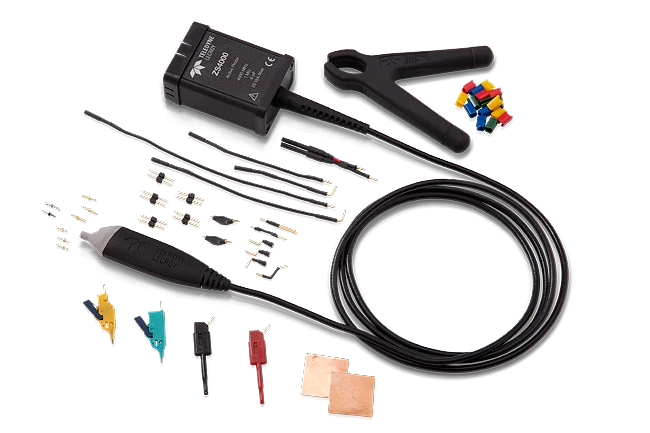
Why it matters: Engineers specifying a new oscilloscope rarely give the same attention to the probe, yet the probe is half the measurement system. At PCIe Gen5, DDR5, or USB4 data rates, a bandwidth-limited or poorly connected probe will distort edge rates, misread jitter, and send debug sessions chasing artifacts that do not exist in the actual design.
Start with bandwidth—and don't cut it close
Probe bandwidth must cover the highest frequency content of the signal under test, not just the data rate. For high-speed digital interfaces, the significant harmonics extend well beyond the fundamental. A probe with bandwidth equal to the interface's signalling rate will attenuate high-frequency content, slow measured rise times, and reduce visible overshoot and ringing—making clean signals look cleaner than they are and hiding real problems in marginal designs.
As a working rule, probe bandwidth should be at least three to five times the signal's highest significant harmonic. For multi-gigabit interfaces—PCIe Gen4/Gen5, DDR5, USB4—this typically means probes in the tens-of-gigahertz range.
Loading: what the probe does to the circuit
Every probe presents an impedance to the node being measured. Input capacitance, resistance, and tip inductance can reduce signal amplitude, slow edge rates, and introduce ringing that appears to be a design flaw. On sensitive high-speed nodes—low-swing differential pairs, DDR data lines, PCIe transmitter outputs—probe loading is not a second-order concern. It directly affects what the oscilloscope records.
Active probes address this by placing a high-impedance amplifier at the probe tip, keeping input capacitance very low and minimising the electrical footprint on the circuit. Passive probes are simpler and affordable but their loading characteristics make them unsuitable for most multi-gigabit applications.
Passive vs active: matching technology to application
- Passive probes suit general-purpose debugging, power electronics, embedded systems, and lower-frequency analogue circuits. Affordable and robust, but bandwidth and loading constraints limit usefulness above a few hundred megahertz.
- Active probes are required for PCIe validation, DDR memory debugging, high-speed serial interfaces, and RF characterisation. Amplifier circuitry at the tip delivers significantly higher bandwidth and far lower input capacitance, preserving signal fidelity on the nodes that matter most in modern designs.
- Differential probes are essential for interfaces that use differential signalling—PCIe, USB4, Ethernet, MIPI, DisplayPort. Single-ended probing of a differential signal introduces measurement errors and suppresses real common-mode noise behaviour. Differential probes provide accurate differential voltage measurement, reject common-mode noise, and eliminate ground loop issues.
Physical access: a challenge that shapes probe choice
Measurement intent and probe technology only matter if you can actually reach the signal. Modern PCBs feature fine-pitch BGAs, dense routing, high-speed differential pairs with no exposed test pads, and embedded test points accessible only through interposers. The right probe accessory—solder-in tips, browser probes, differential heads, remote sampling heads—determines whether a measurement is possible at all and whether the connection disturbs the signal being observed.
Selecting probe accessories alongside the probe itself, rather than as an afterthought, prevents situations where the right probe exists but cannot be connected without invalidating the measurement.
Match probe to measurement objective
- General functional debugging: passive probe with adequate bandwidth for the signals under test.
- Power rail and integrity analysis: low-noise passive or rail probe optimised for small AC ripple on a DC bias.
- DDR memory validation: high-bandwidth active probe; loading must be low enough not to alter timing margins.
- PCIe compliance testing: differential active probe matched to the spec's receiver operating conditions.
- MIPI debug: active probe or remote sampling head suited to the interface's low-voltage swing.
Defining the measurement objective first eliminates unnecessary complexity. It also prevents over-specifying for routine work and under-specifying for the measurements where accuracy matters most.
The probe and oscilloscope as a system
Oscilloscope and probe bandwidth specifications are independent but the measurement system has only one bandwidth—determined by how the two interact. A 20 GHz oscilloscope paired with a 4 GHz probe produces a 4 GHz measurement system. Calibration accuracy, interconnect quality, and fixture design further influence what the system captures. The best results come from selecting the oscilloscope, probe, and accessories together, with the target measurement application as the design constraint—not from selecting the oscilloscope and treating the probe as interchangeable.
Primeasure POV
- Audit your existing probe inventory against current project bandwidth requirements—especially if PCIe Gen4/Gen5 or DDR5 have come into scope since the probes were originally purchased.
- For differential interfaces, standardise on differential active probes rather than using two single-ended probes with math subtraction; the common-mode rejection difference is significant in compliance and margining work.
- Factor physical access into probe selection early in the hardware bring-up plan—probe accessory availability is often the bottleneck that delays first-silicon measurements.
- Treat calibration as part of the measurement chain: probe-to-oscilloscope deskew, tip calibration, and verified attenuation settings should be documented per bench, not left to individual engineers before each session.
Need Help Selecting the Right Probe?
Primeasure works with engineers across semiconductor, embedded, automotive, and high-speed digital design to identify the right oscilloscope and probing solution for each measurement challenge.
Explore Primeasure's Probes & Accessories available across India.
Talk to PrimeasureSource: Selecting the Right Oscilloscope Probe for High-Speed Measurements — industry guidance on probe bandwidth, loading, technology selection, and measurement system design.