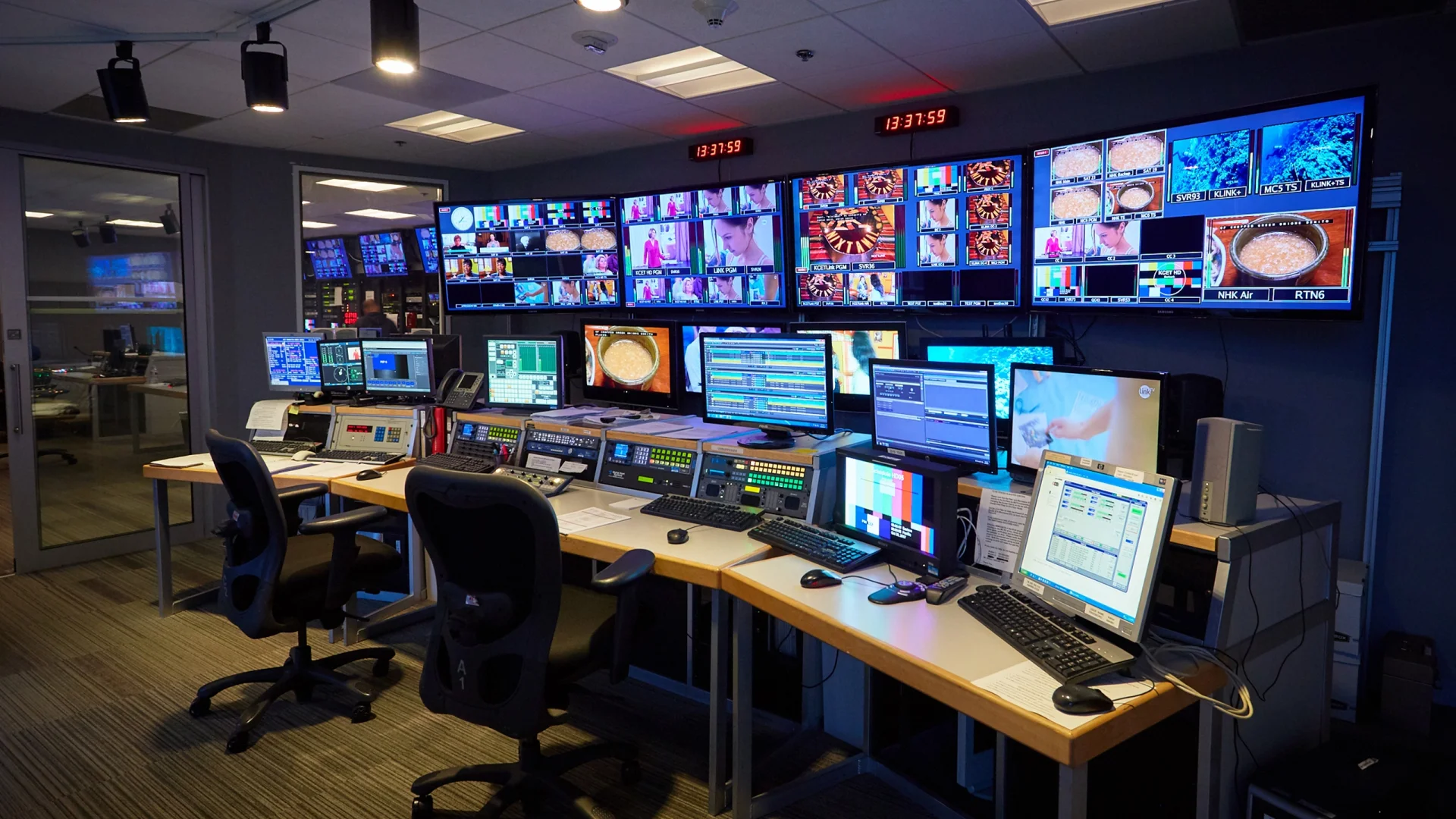
Why it matters: Live sports production is no longer synonymous with a fleet of OB trucks parked outside the stadium. REMI workflows move the bulk of production—replay, graphics, audio mixing, directing—into a centralised facility, allowing broadcasters to cover more events at lower cost without sacrificing broadcast-grade quality. For India's rapidly expanding sports media landscape, the timing is right.
What remote production actually means
REMI (Remote Integration Model), also called at-home production, transports camera, audio, and data feeds from a venue over high-bandwidth IP networks to a centralised production hub. At the venue, only the minimum essential crew remains—camera operators, technical coordinators, and audio engineers capturing the raw feed. Everything else—switching, replay, graphics insertion, commentary, and production management—runs from a single facility that can serve multiple events simultaneously.
This is not a cost-cutting workaround. Done correctly, REMI delivers the same production quality as a full on-site deployment because the infrastructure and talent are centralised rather than distributed across dozens of separate OB trucks.
Why broadcasters are adopting REMI now
- Reduced operational costs: Fewer personnel and less equipment travel to each venue, cutting transportation, accommodation, and logistics spend—particularly valuable for regional leagues and secondary competitions that cannot justify a full OB deployment.
- Greater event coverage: A centralised production team can support multiple simultaneous events from a single facility, enabling sports networks to scale coverage without proportionally scaling headcount.
- Better resource utilisation: Replay operators, graphics teams, and technical directors are shared across productions rather than locked to a single event, improving efficiency and talent utilisation.
- Consistent quality across venues: Production infrastructure lives in one controlled environment, eliminating the variability that comes from assembling and disassembling equipment at different venues throughout a season.
The technical requirements that define success
Remote production is not simply a connectivity problem. Several interdependent layers must work reliably together.
- IP contribution networks: High-quality video, audio, and metadata must travel from venue to hub with low latency and high reliability. Modern REMI workflows combine fiber, bonded cellular, and public internet paths with automatic failover to maintain continuity.
- Centralised production infrastructure: Production switchers, replay systems, graphics engines, multiviewers, and audio consoles housed in a central facility reduce duplicated equipment across venues and simplify maintenance.
- Synchronisation and timing: Maintaining frame-accurate synchronisation between video feeds, replay servers, graphics, and remote commentary is non-negotiable for a seamless viewer experience.
- Real-time signal monitoring: As the workflow becomes distributed, comprehensive visibility into network performance, packet loss, latency, and signal quality becomes essential—problems must be caught before they reach air.
The challenges broadcasters must plan for
REMI shifts operational risk rather than eliminating it. Latency management is the most visible challenge: delays between venue feeds, production systems, and remote commentators compound quickly in live sport, where split-second timing matters. Network reliability becomes a shared dependency—any degradation in the contribution path affects every function the remote team is performing simultaneously. Multi-site coordination also requires investment in robust intercom, monitoring, and control systems that allow geographically separated teams to operate as a single cohesive unit.
Organisations that treat remote production as a connectivity exercise and under-invest in monitoring, redundancy, and synchronisation infrastructure tend to discover the gaps at the worst possible moment—during a live final or a high-stakes match.
Primeasure POV
- Evaluate your highest-risk production scenarios first—finals, flagship matches, multi-venue tournament days—and define the redundancy and monitoring standards those events require before selecting infrastructure.
- IP contribution reliability is the single most load-bearing element of a REMI workflow; invest in resilient transport with automated failover rather than treating network connectivity as a commodity afterthought.
- Build signal monitoring into the architecture from the start, not as an add-on. Distributed workflows multiply the number of points where quality can degrade silently; you need visibility across every hop from camera to transmission.
- Plan for centralisation gradually—start with productions where the latency and coordination stakes are lower, build operational confidence, then extend the model to flagship live events.
Planning a Remote Production Infrastructure?
Primeasure can help assess your contribution network requirements, evaluate centralised production architectures, and plan a REMI deployment suited to India's broadcast environment.
Explore Primeasure's Broadcast solutions available across India.
Talk to PrimeasureSource: Remote Production Workflows for Live Sports Broadcasting — industry overview of REMI and at-home production workflows.